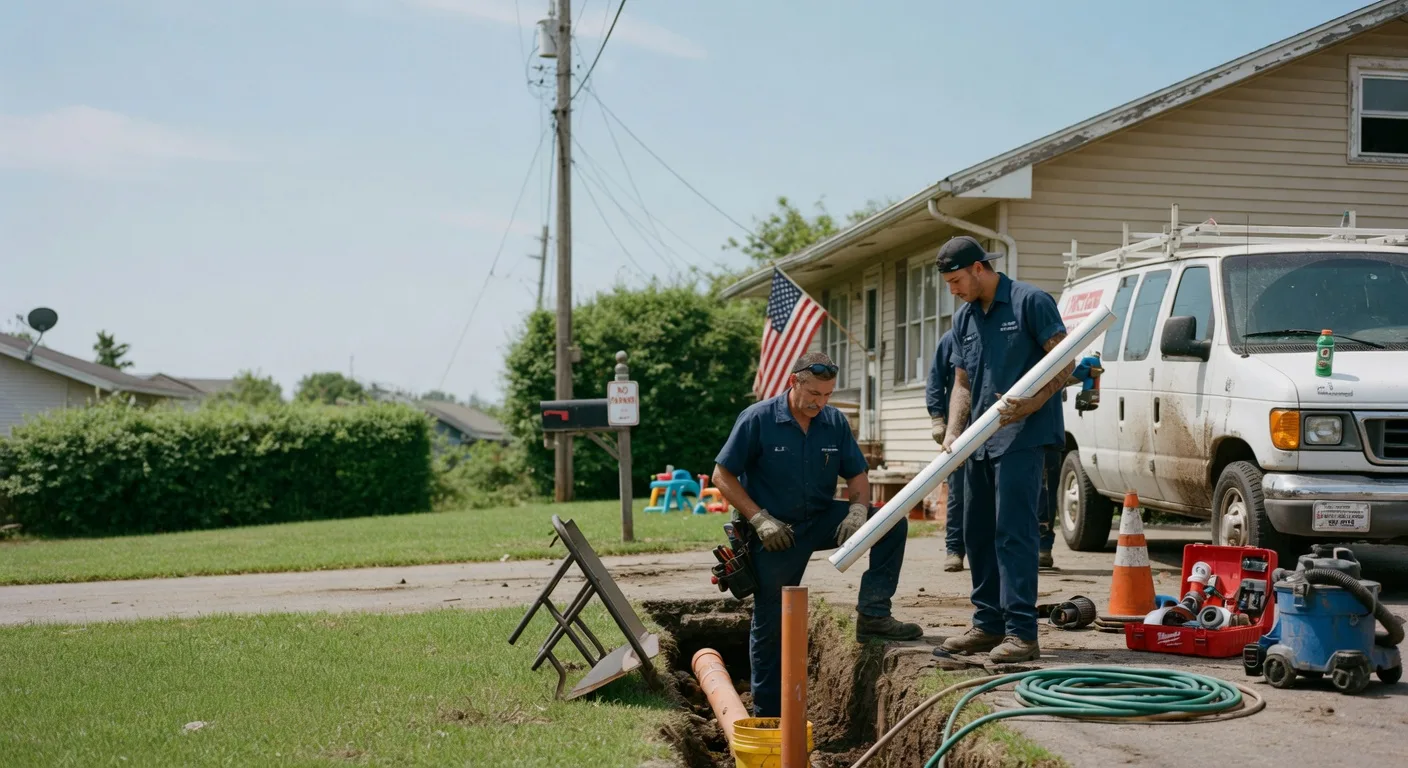
Why does the same drain keep clogging again just days after it was cleared?
A clog that returns within days almost always means one of two things. Either the first cleaning opened a path without removing the whole blockage, or the real cause was never touched. A cable machine punches a channel through the middle of a clog. That restores flow, but it can leave a ring of grease, scale, or packed debris clinging to the pipe wall, and that ring catches the next load of waste quickly. Underneath that sit the causes a cable cannot fix: roots growing in at a clay joint, a bellied section holding standing water, a cracked or offset joint catching paper, or rough scale in cast iron. Start by noting whether it is one fixture or several. A single kitchen or bathroom line that refills fast often needs hydro jetting, which scours the full width of the pipe wall rather than opening a hole through the center. A repeat clog in the main, or several fixtures slowing together, needs a camera inspection, because it shows the pipe's condition instead of just clearing it again. Chemical cleaner between visits usually makes things worse for the next tool. Expert Plumbers Co connects homeowners in Perry, OK with an independent local plumber who can find out why the drain will not stay clear. Access to the line and how much of it must be opened up are what shape the repair.
Clearing a drain is not the end of the story, and knowing what to do afterward keeps the clog from coming back. Once a line is cleared, run hot water for a minute, then fill the sink and let it drain to check the flow. Use a drain strainer in showers and kitchen sinks to catch hair and food scraps before they enter the pipe. Keep a note of the date and what the plumber found, because a second clog in the same place within a few months is useful information. If hair is the cause, a monthly manual clean of the strainer and stopper helps more than any product. If the plumber mentions roots, a bellied pipe, or a cracked joint, ask what the options are and how quickly the problem is likely to return. Older homes often have cast iron or clay lines, where recurring trouble is more common than in newer plastic pipe.
Why does my house smell like sewage even though nothing is backed up?
A sewer smell with no visible backup usually means sewer gas is getting into the house through a path other than a clog. The most common cause is a dry trap. Every drain has a U-shaped trap that holds water as a seal, and in a rarely used drain, like a basement floor drain or a guest bathroom, that water evaporates. Pouring a bucket of water down the drain refills the seal, and it often fixes the smell in minutes, so that is a safe homeowner check. A loose or failed wax ring under a toilet can leak gas at the base, and a rocking toilet is a clue. A cracked vent pipe in the attic or wall can release gas inside the house. Outside, a damaged sewer line or an open cleanout can send the smell into the yard and then indoors. If the smell is strong, comes with slow drains, or you feel dizzy or sick, leave the area and call right away. If it lingers after you refill the traps, the vent stack or the sewer line itself may need a camera check. Call Expert Plumbers Co at (380) 262-9173 to get connected with an independent local plumber in Perry, OK.
One thing worth knowing is that the smell often follows a pattern, and the pattern points to the source. If it is strongest right after you run a shower or flush a toilet, the gas is probably escaping from a leaking drain joint or a cracked vent inside a wall. If it comes and goes with the weather, a low-pressure day or strong wind can pull gas back down a vent. In older homes, deteriorated cast iron or lead-and-oakum joints are common leak points. Newer homes with plastic pipe more often have a missed glue joint or a dried trap. When you talk to the plumber, say which room the smell is in, what time of day it shows up, and whether it changes after water use. That detail can save an hour of searching. Expect the fix to be small if a trap or wax ring is the cause, and larger if a wall has to be opened to reach a joint.
What is a bellied or sagging sewer line, and can it be cleaned?
A belly is a low spot in the sewer line where the pipe has sunk. Water and waste stop and sit in the dip instead of flowing on. Solids settle there, grease coats the pipe wall and paper catches. You see it as drains that run slow, a toilet that needs repeated flushing, or a line that clogs again a few weeks after it was cleared.
The cause is usually a pipe that lost support underneath it, or a joint that shifted.
Can it be cleaned? Yes, up to a point. A cable machine can open a blockage sitting in the belly, and hydro jetting can wash grease and buildup off the pipe wall. Neither fixes the dip. The belly keeps holding water, so the buildup returns.
A camera inspection tells you the rest. It shows how deep the belly is, whether the pipe is cracked, and whether roots have entered a joint. Cost depends on how deep the line is, how much has to be dug up or removed, the materials involved and any permit.
Safe homeowner check: note whether one fixture or the whole house is slow. One fixture points to its own branch. Every drain slow points to the main line.
Stop running water and call now if sewage is coming up in a tub, shower or floor drain.
Expert Plumbers Co is a referral service. Call (380) 262-9173 and we will connect you with a plumber serving Perry, OK for Drain Cleaning or Emergency Drain Cleaning.
Left alone, a belly tends to get worse in a predictable way. The standing water softens the soil around the pipe further, the dip deepens, and the clogs come back faster each time. Another warning sign is a faint sewage smell in the yard or a patch of lawn that sinks or stays wet, which can mean the pipe has separated at a joint. Older homes with clay or cast iron lines are the most likely to have a belly, because those pipes sit in sections and shift as soil settles. Newer plastic lines can also sag when the trench bedding was uneven. When you speak to the plumber, ask what the camera shows about the depth of the dip and the condition of the pipe at that spot. If the pipe is intact, a spot repair may be possible. If it is cracked, replacing that section is the lasting fix.
The street sewer backed up into my house. What is a backwater valve?
Sewage came up through the basement floor drain, or a low toilet or tub gurgled and overflowed, during a storm or a heavy-use evening.
The usual cause is the municipal main in the street filling past capacity, called surcharging. With nowhere to go, the flow pushes back up the lateral and out of the lowest opening in the house.
A backwater valve, also called a check valve, is a fitting on the lateral or building drain with a flap that lets waste leave and shuts when flow reverses. It sits on the line ahead of the branches serving the lowest fixtures.
Fitting one is not a quick swap. It usually means opening the floor or digging to reach the pipe. What it involves depends on access, the depth of the line, the valve and materials, how much has to be opened up and restored, and whether a permit or code sign-off is required. Rules vary by area.
A valve does not fix roots at a clay joint or a bellied line holding water. It only stops reverse flow. A private line problem needs a camera inspection first, then a cable machine or hydro jetting depending on what the camera shows.
Street or private? Ask three things. Are the neighbors affected? Did it coincide with heavy rain? Is only the lowest opening backing up while upper fixtures drain normally? Yes to those points to the street main. Only your house, in dry weather, points to your own lateral.
Safe homeowner check: look at the neighbors and the forecast. Stop running water now: no flushing, washer or dishwasher. Keep people and pets out of contaminated water, and call.
Expert Plumbers Co is a referral service. We connect you with an independent local plumber in Perry, OK. Call (380) 262-9173.
After the cleanup, ask how the valve will be kept working. The flap and its hinge can be stopped by lint, grease and grit, and then it no longer seats fully. Most valves have an access cover so the flap can be looked at and cleaned, and that should be done on a routine, not only after a storm. Learn where the cover is and keep boxes and floor coverings off it.
One point catches people out. With the valve closed during a storm, your own household water has nowhere to go either. Showers, sinks and the washer will fill the line behind the flap, so keep water use low until the street main drops.
After any backup, the floor drain and the area around it need to be cleaned and disinfected. Porous materials that soaked up sewage, such as carpet pad and cardboard, usually have to be removed rather than dried.
The city is replacing the street main outside our house. Why are our drains acting up now?
The crew has been digging up the street for a week, and now your toilets gurgle, the tub drains slowly, or you saw muddy water in a floor drain. It is natural to suspect the work outside. There are a few real reasons why it can be connected.
Your house drain, called the lateral, runs from your foundation to a connection on the city main. When the main is dug up and replaced, that connection is cut and reattached. Vibration, trench work and heavy equipment can crack an older clay or cast iron lateral, push a joint out of line, or shift the pipe so water now pools in a low spot. Dirt, gravel and construction debris can also wash into the line while connections are open. The work can also cause temporary backups while flow is being rerouted or the new pipe is flushed.
The key question is whether it is one fixture or the whole house. A single slow sink is probably the fixture. If every drain is sluggish, gurgling or backing up at once, particularly the lowest ones, the trouble is in the lateral or the main, and the street work is a likely suspect.
Safe homeowner check: write down when the symptoms began and compare that to when work started near your address. Take photos of any muddy water, debris or wet floor. Check whether neighbors have the same trouble. Run one tap for a minute and see if the lowest drain in the house reacts.
Stop running water and call now if sewage is coming up in a tub or floor drain, if there is standing water in the basement, or if you smell sewage inside the house. Do not keep using the washer or dishwasher.
Tell the utility or the contractor promptly. They may have a claims process, and a delay can make it harder to show when the damage started. A cable machine may be enough if loose debris is the problem. If the lateral is cracked, offset or holding water, the plumber will need a camera inspection to see the damage, and hydro jetting can flush out silt and gravel.
Expert Plumbers Co is a referral service. We connect you with an independent local plumber in Perry, OK. Call (380) 262-9173.
Ask the plumber to record the camera inspection and write down the footage location of any damage, so you can give it to the city or contractor. Scope depends on how deep the pipe is, how much has to be dug up or opened, parts and materials, and any permit or code requirement. Responsibility for the repair varies by area, so confirm who owns which section of the line.